Purchase order management for Shopify warehouses
SKUSavvy is a purchase order management system for Shopify brands that run their own warehouse. Build vendor POs from real sales and lead times, send them to the vendor, check them in by scan, and put every unit away to a bin. Shopify's count updates the moment stock lands.
What is a purchase order management system?
A purchase order management system tracks what you buy from vendors, from the moment you decide to reorder until the stock is on a shelf. It holds your vendors and their costs, builds and sends each purchase order, records what actually arrived, and updates inventory so your sales channels can sell it.
Shopify Admin covers light purchasing. It does not tell your receiver which bin a carton goes to, or flag that a vendor shipped 40 of the 50 you paid for. That is where a warehouse needs more than a PO form.
Who you buy from
Vendors with their own SKUs, unit costs, and lead times per variant, so every order starts from the right numbers.
What you ordered
Purchase orders with line costs, a delivery date, a destination warehouse, notes, and freight or duty on top.
What actually arrived
Scanned check-in against the PO, partial shipments, discrepancies, and put-away to the bin each unit lives in.
When Shopify purchase orders and spreadsheets stop being enough
Most brands start with a reorder sheet and an email to the vendor. These are the four places that breaks.
Reorders come from memory
Someone eyeballs the sheet at month end. Fast movers run out before the next order arrives, and slow movers get reordered anyway.
Short shipments go unnoticed
The box says 50, the vendor sent 40, and nobody counted. The missing 10 show up later as oversells.
Received stock has no address
Cartons land in the aisle or overflow with no bin. Shopify says you have it. Pickers can't find it.
Unit costs ignore freight
The vendor price goes into your margins, but freight and duty never reach the cost of each unit.
How purchasing works in SKUSavvy
The full loop runs in one system: build the order, send it, receive it, put it away, and reorder. These are real screens; customer data is anonymized.

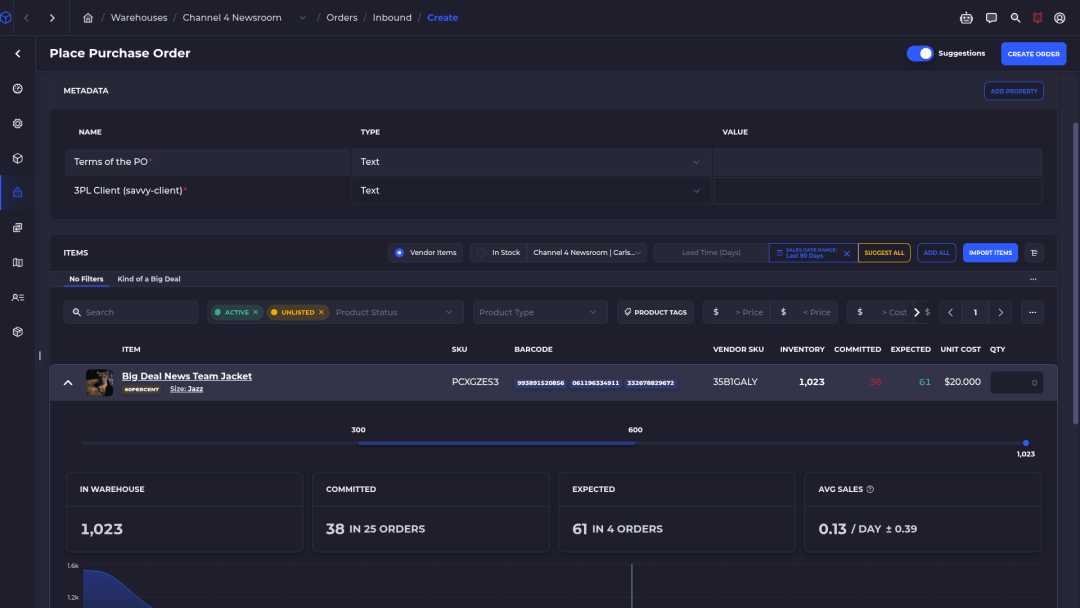
Build the PO, then send it to the vendor
Pick a vendor and turn on suggestions. SKUSavvy fills each line from your min and max, stock on hand, committed and incoming quantities, and sales over the date range you choose. Edit anything, add freight or duty, and set the delivery date.
Turn on email for the vendor and every PO arrives with a link to the vendor portal, where the vendor can confirm it, adjust it, or cancel it. Changes live on the PO, not in an inbox. A vendor that runs SKUSavvy can connect instead, and get each PO as an order in its own account.
Check it in by scan and put it away to bins
When the shipment arrives, open the PO and check it in with a scanner or the phone camera. One PO can arrive in several shipments. Receive less than you ordered and SKUSavvy logs the discrepancy and keeps the rest open, or you close it out.
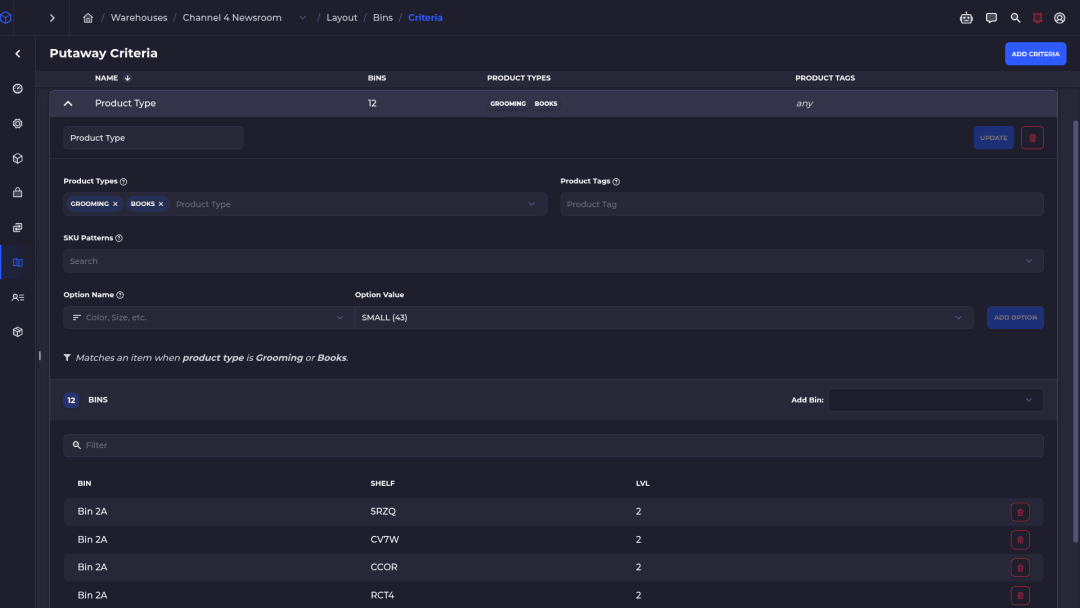
Putaway criteria match items by product type, tag, SKU pattern, or option and point them at the right bins, so inbound stock lands where pickers expect it.
Min–max replenishment
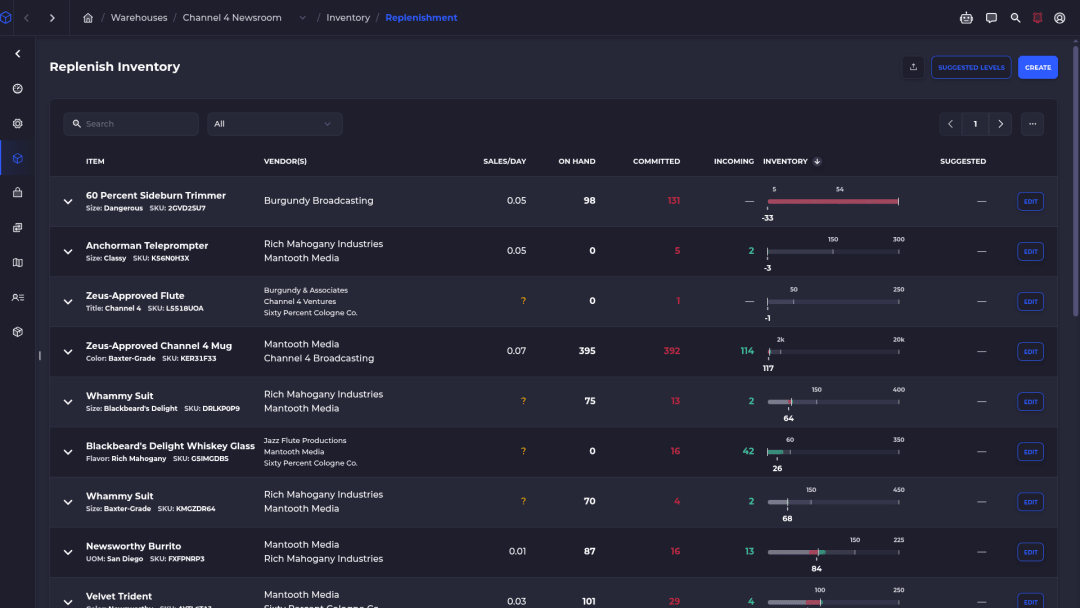
Replenish Inventory puts every item's min and max on one table, next to its sales per day and its on hand, committed, and incoming quantities. A bar shows where stock sits against the two levels, and Edit on the row changes them.
Suggested Par Levels computes a min and max from recent sales, how often the item was in stock, and lead time, and you accept each one with a click. Once an item has levels, Low Stock and Reorder Radar know when to flag it.
Purchase order management features
Use this as a checklist when you compare purchase order software for a Shopify warehouse, including ours. Each card says what the feature does and what it changes for you.
Vendors and vendor items
Vendor SKU, unit cost, and lead time per variant, with average and worst-case lead time shown for each vendor.
Every PO starts from the right cost.
Replenishment suggestions
Turn on suggestions while you build a PO and each line is sized from par levels, stock, commitments, incoming POs and transfers, and sales.
You edit a number instead of starting from blank.
Landed costs
Add freight, duty, tax, fee, or insurance to the PO and split it by quantity, value, or weight.
Unit cost reflects what the stock cost to land.
PO approval
Turn on approval and POs created by buyers wait in Pending Approval until an approver signs off.
Nothing reaches a vendor without a yes.
Vendor portal
Vendors get the PO by email and can confirm, adjust, or cancel it in the portal.
No more chasing confirmations in a thread.
Scanned check-in
Receive by barcode against the PO, across several shipments, with discrepancies logged on partials.
You know exactly what arrived.
Directed put-away
Rules send inbound items to the right bins by product type, tag, SKU pattern, or option.
Received stock is pickable, not lost in overflow.
Par levels and Reorder Radar
Min and max per item, suggested levels, and a forward look at which vendors need an order now.
You reorder before the shelf runs dry.
Import, API, and accounting sync
Import PO lines from a CSV, create POs through the GraphQL API, and turn received POs into bills in QuickBooks (paid add-on).
Nobody retypes the same order twice.
What changes when purchasing runs in the WMS
The short version, for the person who signs the vendor checks.
Fewer stockouts
Reorder Radar flags items that will drop below their minimum before a new order could arrive, while there is still time to act.
Counts right at the dock
Scanned check-in catches short shipments at receiving, not weeks later as an oversell.
True unit costs
Landed costs ride on the stock itself, so cost of goods sold reflects freight and duty.
Every buyer included
Seats are unlimited, so buyers, approvers, and receivers don't each add a license.
AI purchase order suggestions with a person in charge
SKUSavvy uses AI to size purchase orders and to answer questions about your stock. It suggests and explains. A person decides what gets ordered.
Reorder Radar: AI-powered forecasting by vendor
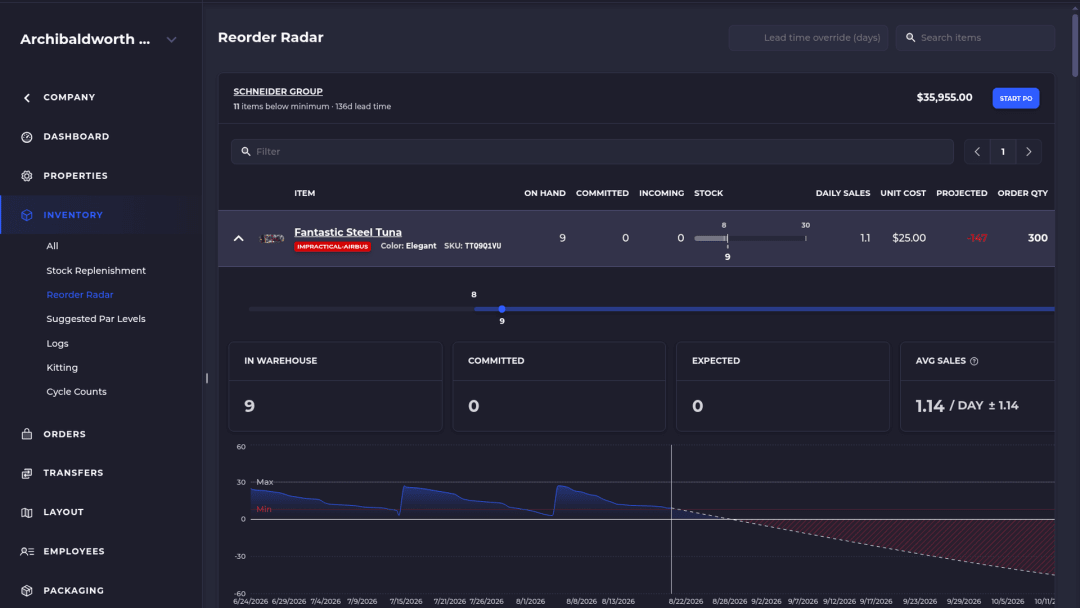
Reorder Radar looks ahead. An item shows up when it is projected to fall below its minimum before a PO placed today could arrive, based on stock, commitments, incoming orders, and expected sales over the vendor's lead time.
Items are grouped by vendor with a suggested quantity that refills to your max. Start PO opens a prefilled order. Nothing is ordered until you review it and submit it yourself.
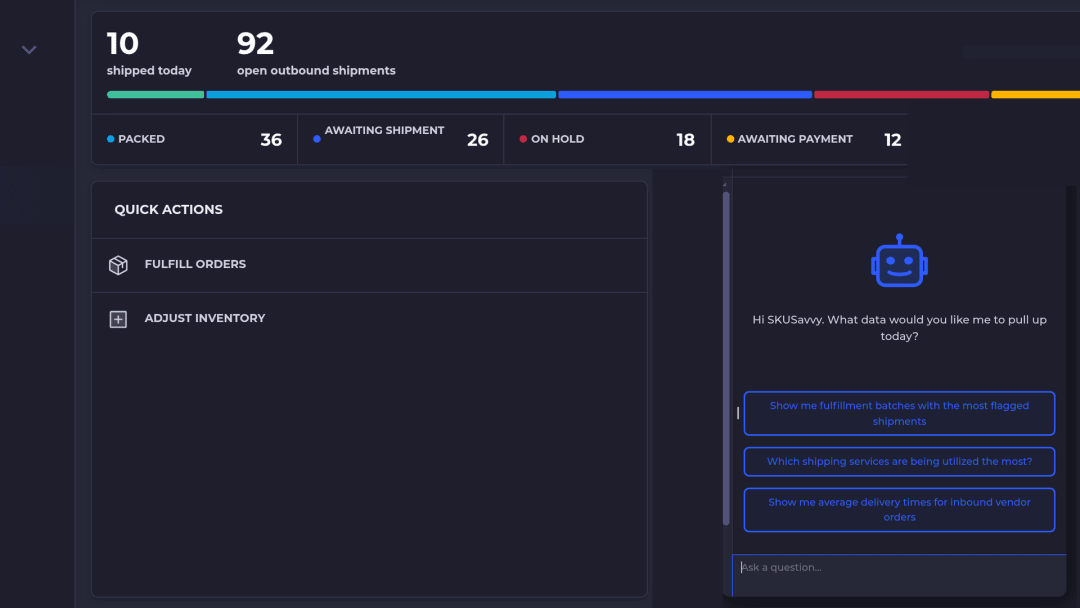
Ask SavvyBot about vendors and inbound stock
SavvyBot is the assistant in the SKUSavvy sidebar. Ask how long inbound vendor orders take to arrive or which items are running low, and it looks up live data, builds a chart or a CSV export, or opens the right screen.
It can take actions in your account only after you explicitly approve them. SavvyBot runs on AI credits.
A GraphQL API for purchasing agents
Low-stock products, forecasts, inventory, and purchase orders sit behind one GraphQL API, and inboundOrderCreate creates a PO from a script or an agent. API calls are included in every plan.
Why it suits an inventory agentPick routing once stock is shelved
When the stock you bought turns into orders, SKUSavvy plans each pick path against your actual warehouse layout.
See the full WMSThe reorder math, in plain view
Suggestions are only useful if you can check them. These are the inputs and the formulas SKUSavvy uses.
| Input | Where it comes from |
|---|---|
Min and max | Set per item, or accepted from Suggested Par Levels |
Lead time | Learned from your PO history, from created to received, or set by hand per vendor |
On hand and committed | Stock in bins, minus what open orders have claimed |
Incoming | Open purchase orders and transfers |
Sales velocity | Average daily sales over the date range you pick |
Reorder point: lead time in days × daily sales velocity, plus safety stock. Reorder quantity: target days of stock × daily sales velocity. Radar rounds each suggestion up to the vendor's order step.
Spreadsheet purchasing vs SKUSavvy
Same job, two ways to run it.
| Job | Spreadsheet and email | SKUSavvy |
|---|---|---|
Decide what to reorder | Scan the sheet at month end | Reorder Radar and Low Stock flag items by vendor |
Size each line | Guess from last order | Suggestions from par levels, sales, and lead time |
Send and confirm | Email a PDF, wait for a reply | Email with a vendor portal link to confirm or adjust |
Receive | Count the boxes, update a cell | Scan against the PO, log short shipments |
Put away | Wherever there is room | Put-away rules point each item to its bins |
Update Shopify | Edit quantities by hand | Available syncs to Shopify as stock is received |
If you keep creating purchase orders in Shopify while SKUSavvy runs the warehouse, received stock has to be resynced and assigned to bins by hand. Creating POs in SKUSavvy avoids that step.
After Stocky: purchase orders plus the warehouse floor
Shopify's Stocky app is no longer available, and Shopify Admin now covers light purchase orders. If you only need to place and receive POs, that may be enough. If you also need bins, scanned receiving, put-away, and pick paths, that is a WMS job, and purchasing comes with it in SKUSavvy.
What purchase order management costs
Purchasing is part of the plan, not a separate module. SKUSavvy costs $179 a month, which includes your first 249 orders, then a per-order rate that drops as volume grows. Purchase orders, transfers, and POS orders count toward the monthly total, the same as online orders.
Seats are unlimited, plans run month to month, and every account starts with a 30-day free trial with no credit card.
Estimate your bill on the SKUSavvy pricing pageCompare WMS pricing models and what each includesPurchase order management FAQ
Straight answers for Shopify brands that buy, receive, and ship their own stock.
What is purchase order management software?
Software that runs the buying side of inventory: vendors and costs, creating and sending purchase orders, receiving what arrives, and updating stock. In a WMS like SKUSavvy it also puts received stock away to bins, so it can be picked right away.
Can I manage Shopify purchase orders in SKUSavvy?
Yes. Create the PO in SKUSavvy instead of Shopify. When it is received, stock is added to bins and the Available quantity syncs to the matching Shopify location in real time.
Does Reorder Radar place purchase orders by itself?
No. Radar shows which vendors need an order and suggests quantities. Start PO opens a prefilled draft, and nothing is ordered until you review it and submit it.
How does SKUSavvy calculate reorder quantities?
From min and max par levels, stock on hand, committed and incoming quantities, sales velocity, and lead time. The reorder point is lead time × daily sales velocity plus safety stock, and Radar suggests enough to refill to your max.
Where do lead times come from?
SKUSavvy learns them from your purchase order history, from created to received, and shows the average and worst case per vendor. You can also set a default lead time by hand.
Can vendors confirm a purchase order online?
Yes. Turn on email communication for the vendor and each PO is emailed with a link to the vendor portal, where the vendor can confirm, adjust, or cancel it. A vendor that runs SKUSavvy can connect instead: each PO lands in its account as an order, with no PDFs, retyping, or integration to maintain.
Can I require approval before a PO is sent?
Yes. Turn on PO approval and assign approver roles. POs created by buyers wait in Pending Approval until an approver approves or rejects them.
How do I receive a partial shipment?
Check in what arrived. SKUSavvy logs the discrepancy and keeps the rest of the PO open for the next shipment, or you can close it out early.
How are landed costs allocated?
Add each freight, duty, tax, fee, or insurance invoice to the PO, then split it by quantity, value, or weight. The landed cost is stored on the stock, so cost of goods sold reflects it.
Can one PO deliver to several warehouses?
A PO has one destination warehouse and one delivery date. Teams with several locations usually receive at one warehouse and move stock with transfer orders.
Does SKUSavvy sync purchase orders to QuickBooks (paid add-on)?
Yes, with the QuickBooks integration (paid add-on). Received POs create bills for the received quantity, and vendors and inventory costs sync too. It does not create customer invoices.
Does SKUSavvy use AI for purchasing?
Yes, with a person in charge. AI-powered forecasting suggests what to order and how much, and you confirm every order. SavvyBot answers questions about vendors and stock and changes nothing without your explicit approval.
Can an AI agent create purchase orders?
Yes, through the GraphQL API. An agent or script can read low-stock products and forecasts and create a PO with inboundOrderCreate. API calls are included in every plan.
What does purchase order management cost in SKUSavvy?
It is included. $179 a month covers your first 249 orders, then a per-order rate that falls with volume. Purchase orders count as orders, and seats are unlimited.
Related pages
Warehouse management software
The full cloud WMS for Shopify floors: bins, picks, packing, and reorder.
Explore the WMSCloud inventory management
How cloud stock counts reach the floor with par levels, purchase orders, and transfers.
Read the cloud inventory guideWMS pricing
What per-user and order-volume WMS plans cost, and what the price should include.
Compare WMS pricingVendor network
Send POs to vendors on SKUSavvy as orders in their own account. No PDFs, no retyping.
See the vendor networkSKUSavvy pricing
Order-based pricing with unlimited seats and a calculator for your volume.
Open pricingBuy from the numbers. Receive to the bin.
Start a 30-day free trial, or check pricing for your order volume.