Palletization Meaning: A Plain-English Guide for Warehouses
Alex
Palletization means grouping goods onto a pallet so they move as one unit: cartons stacked in a set pattern, secured with stretch wrap or straps, and moved by a forklift or pallet jack instead of box by box. In a warehouse, it's the step where loose cartons become a load a truck, a rack or a receiving dock can take in one move.
If you're here for a tool that plans those builds, start with SKUSavvy's palletization software and pallet calculator. This post is the plain-English side: what the word means, the terms people mix up, pallet sizes, what palletization charges are, and how to tell a good pallet build from a bad one.
What palletizing means in a warehouse
Most warehouses touch pallets at three points, even if every customer order ships in a parcel box.
Inbound. Stock from suppliers usually arrives palletized. Someone checks it in, breaks the pallet down and puts cartons or units away.
Storage. Overstock and bulk stock often sit on pallets in pallet racking or on the floor, so a full pallet can move without restacking.
Outbound. Wholesale, retail replenishment and freight shipments go out palletized. So do transfers to another warehouse or to Amazon or a 3PL.
So even a Shopify brand that ships one box at a time ends up palletizing. It just happens on the dock, not at the packing station.
Palletization, palletizing and the terms around them
| Term | What it means |
|---|---|
Palletization | The overall practice of moving and storing goods as pallet loads |
Palletizing | The physical act of building one pallet: stacking, wrapping, labeling |
Depalletizing | Breaking a pallet back down into cartons or units, usually at receiving |
Unit load | Any group of items handled as one, like a pallet, a slip sheet load or a crate |
Containerization | Loading goods into a shipping container. Pallets often go inside one |
Palletizer | A machine or robot that builds pallets, or software that plans the build |
Pallet types and sizes
Pallet size is mostly set by where the freight is going. Use what your carrier, receiver or marketplace expects, not what's cheapest to buy.
| Size | Where it's standard | Notes |
|---|---|---|
48 x 40 in (GMA) | North America | The common US grocery and retail pallet. If nobody tells you otherwise, it's probably this |
1200 x 800 mm (EUR / EPAL) | Europe | The standard European pallet, sized to fit European trucks and doorways |
1200 x 1000 mm | Europe and Asia | A common industrial size, also one of the ISO pallet sizes |
What are 4-way pallets? A 4-way pallet lets forks enter from all four sides. A 2-way pallet only takes forks from two opposite sides. 4-way pallets are faster to handle in tight aisles and trailers because the driver doesn't have to turn the load to pick it up.
What are pallets made of? Wood is still the most common. Plastic pallets cost more but last longer and wash clean, which matters for food and pharma. Presswood or composite pallets are light and often used for export. Metal pallets show up for very heavy loads or where fire resistance matters.
What makes a good pallet build
A pallet build is only good if it arrives in the same shape it left. These are the rules most warehouse leads give new hires.
Heaviest cartons on the bottom. Light and crushable cartons go on top.
Stay inside the footprint. Cartons hanging over the edge get crushed, torn by forks or snagged on racking.
Pick column or interlocking stacking on purpose. Columns stack cartons corner on corner and use the box's full stacking strength. Interlocking (brick) patterns tie layers together for stability but lean on weaker parts of the box.
Respect the height limit. Your carrier, receiver or rack sets it. Ask before you build.
Wrap it tight and label every pallet. Wrap from the base up and tie the load to the pallet. Then put a label on each side you'll see: what's on it, how many and where it's going.
None of this works if your carton dimensions are guesses. The build is only as good as the length, width, height and weight you start from.
What palletization charges are
Palletization charges are what a 3PL, warehouse or freight forwarder bills to build pallets for you: labor to stack, wrap and label, plus the pallet itself. You'll also see related lines like pallet storage, often billed per pallet per month, and depalletizing or receiving fees on inbound freight.
Rates vary a lot by provider, so read the rate card line by line. Two questions save the most money: is the fee per pallet or per carton, and who supplies the pallets?
Manual, semi-automatic and automated palletizing
Manual. People stack cartons by hand. Most ecommerce and wholesale warehouses work this way.
Semi-automatic. Lift tables, turntables and stretch-wrap machines take the strain out of the job, but a person still places each carton.
Automated. Robotic or conveyor-fed palletizers build loads on their own. They make sense for high, steady volumes of a few carton sizes, like a production line.
If your warehouse ships a mix of SKUs and carton sizes, the win usually isn't a robot. It's knowing the build before anyone starts stacking.
How SKUSavvy helps with palletization and packing
SKUSavvy is a warehouse management system for Shopify sellers. Palletization isn't its whole job, but the same dimensions that plan a pallet also drive how orders get packed. Here's what it does today. The free Palletizer lives on our palletization software page, and box setup is covered in the packaging guide.
| Feature | What it gets you |
|---|---|
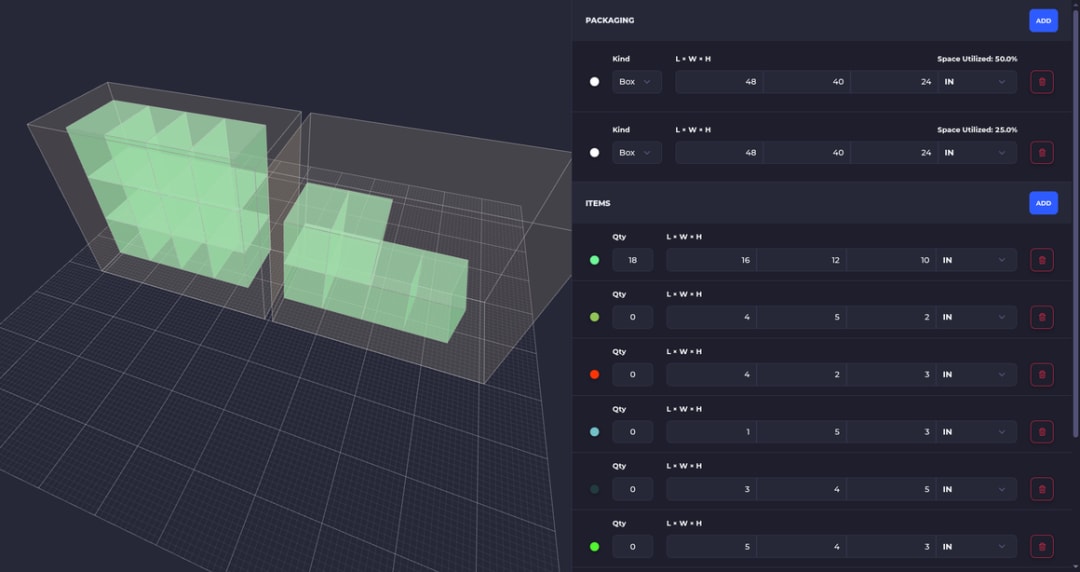
The Palletizer, a free 3D pallet calculator | Enter item and container dimensions and see the build in 3D, from carton to pallet to truckload. Change unit counts to find case and pack sizes |
Works on a phone or tablet | Zoom and move the 3D view on the floor, next to the pallet you're building |
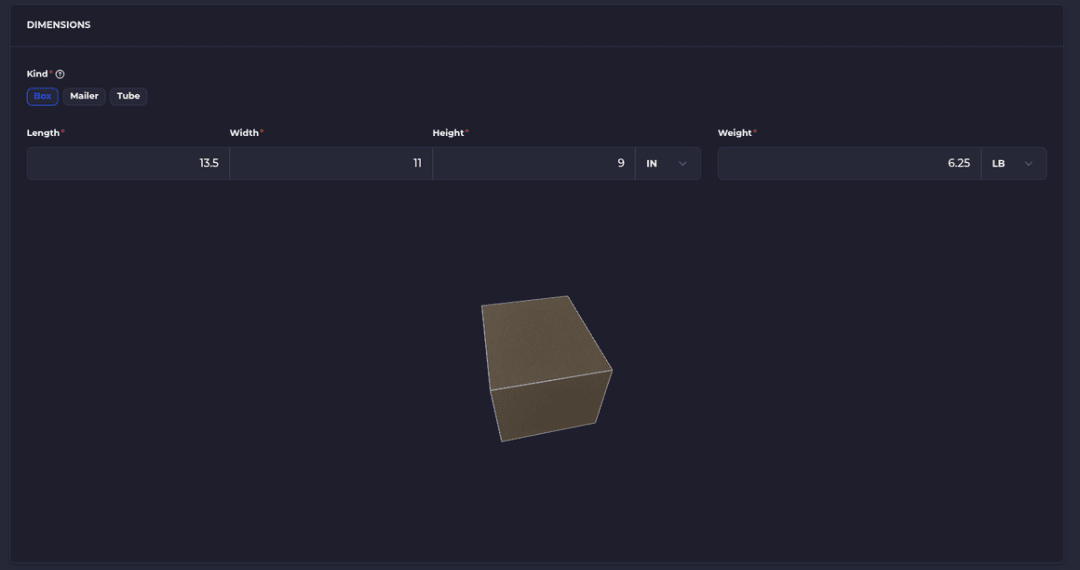
Packaging with real dimensions | Set up boxes, mailers and tubes with dimensions and weight, with a 3D preview of each |
Packaging suggestions at the pack station | When every item has dimensions and a package fits, SKUSavvy suggests one. It starts with what you used last time for the same contents, if it's in stock |
Packaging inventory per warehouse | Optionally track how many of each package you have in each warehouse, with a lead time that sets a reorder point |
Packaging usage export | See what packaging you used over a date range, by warehouse |
The AI part, kept honest
The Palletizer and box suggestions are geometry and rules worked out from your dimensions. They aren't AI: they work from your item dimensions and the packaging you've set up, so you can check every suggestion against real numbers. It's a planning and packing aid, not a TMS and not a system that runs your warehouse for you.
The AI in SKUSavvy is Savvy Bot, the in-app assistant. Ask it about your own orders and inventory, have it run a report like your top sellers this month, or ask how a feature like packaging works, and it explains it and can take you to the right page. It reads and explains. It won't change anything unless you turn on edits and approve each one, and it runs on AI credits. Stacking, wrapping and loading the truck stay physical work on the floor.
SKUSavvy is $179/month including your first 249 orders, then a per-order rate, with a 30-day trial. The Palletizer itself is free to use.
Start a 30-day trialPalletization FAQ
Short answers to what people ask most.
What does palletization mean in shipping?
It means shipping goods as pallet loads instead of loose cartons. The pallet is stacked, wrapped and labeled so it can be loaded, moved and received as one unit, which is how most LTL and full-truckload freight moves.
What is palletizing in a warehouse?
It's the job of building a pallet: choosing the stacking pattern, placing cartons, wrapping the load and labeling it. Warehouses palletize outbound freight and transfers, and depalletize inbound stock from suppliers.
What are 4-way pallets?
Pallets that forklifts and pallet jacks can lift from any of the four sides. 2-way pallets can only be lifted from two opposite sides, so they're slower to handle in tight spaces.
What are palletization charges?
Fees a 3PL, warehouse or forwarder charges to build pallets for you, usually covering labor, wrap, labels and the pallet itself. Pallet storage and depalletizing on inbound freight are usually billed as separate lines.
What are pallets made of?
Mostly wood. Plastic pallets are used where hygiene or reuse matters, presswood or composite pallets for light export loads, and metal pallets for very heavy loads.
Is the SKUSavvy Palletizer free?
Yes. The Palletizer can be used free, and it's also included in every SKUSavvy account for use during fulfillment.
Does SKUSavvy plan freight routes or book trucks?
No. SKUSavvy plans carton, pallet and truckload builds from dimensions and handles picking, packing and labels for your orders. It isn't a transportation management system.
Keep reading
Packaging guide
Set up boxes, mailers and tubes, track packaging stock and get packaging suggestions.
Open the packaging guidePick, pack and ship software
How SKUSavvy runs picking, packing and labels for Shopify orders.
See pick, pack and shipPlan the build before anyone stacks a carton.
Start a 30-day trial or check pricing for your order volume.