custom wms
Most “custom WMS” searches diagnose a warehouse floor that no longer fits its tools—not a settled brief for greenfield software. The real choice is whether the gap needs a build, a packaged product, or configurable warehouse execution.

Custom is usually a diagnosis, not a build brief
Separate the problem before hiring a development shop. If the exceptions are not concrete, the work is still diagnosis—not build scope.
Execution gap
Commerce and shipping work, but the floor lacks bin homes, directed put-away, reliable scan paths, or continuous counts. Configurable floor software usually addresses this faster than a custom build.
Integration gap
Inventory truth is split across Shopify, shipping software, spreadsheets, and perhaps POS. The need is one system of record and clean handoffs—not a new picking algorithm.
True proprietary process
The business wins through software others do not have, such as proprietary robotics orchestration, regulated flows configuration cannot represent, or complex multi-tenant billing. This is the narrow strategic build case.
Custom-built vs. off-the-shelf vs. configurable WMS
The market is not a binary between a rigid package and bespoke software. A configurable WMS can fit distinct floor workflows using proven warehouse primitives without making the operator its own software vendor.
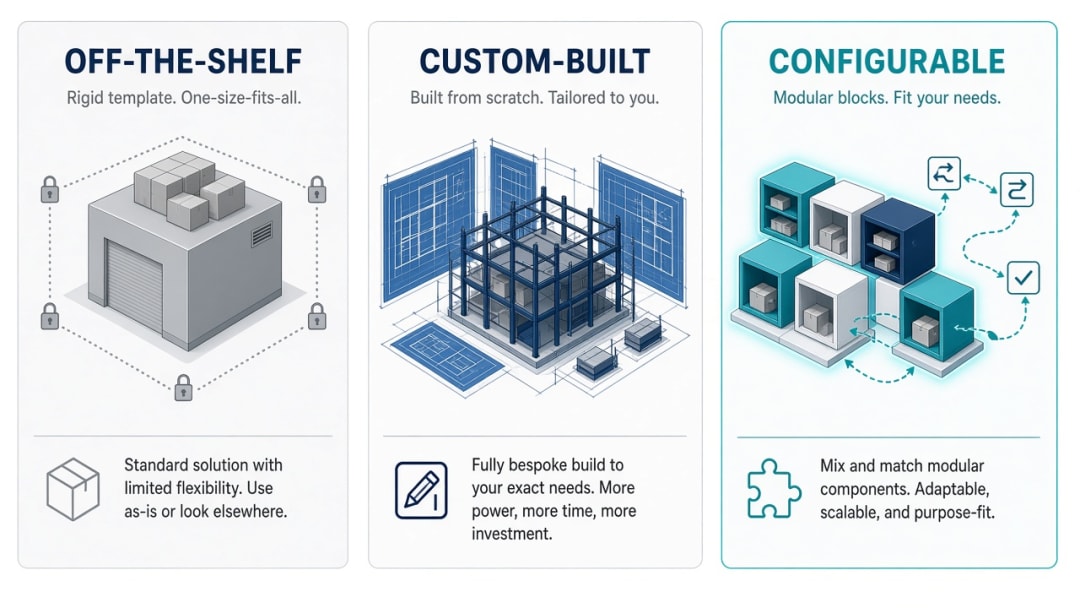
| Approach | Best fit | Main advantage | Main tradeoff |
Off-the-shelf WMS | Standard warehouse processes | Faster start and established support | The floor conforms to fixed workflows |
Custom-built WMS | Proprietary processes that create competitive value | Control of logic, architecture, and roadmap | Cost, time, and permanent product ownership |
Configurable WMS | Distinct workflows built from common warehouse activities | Operational fit without funding a software company | You stay inside supported platform boundaries |
When building a custom WMS is justified
Build when unique software is strategically important and configuration cannot represent a few non-negotiable workflows—not when the case is only a long wish list.
Strategic software
Good candidates include a multi-tenant platform intended for resale, proprietary robotics, specialized SAP-centered material flows, regulated constraints, or complex 3PL billing and ownership logic.
Basic-tool pain is not a mandate
A storefront, shipping tool, spreadsheets, and institutional knowledge point to a warehouse execution gap, not necessarily a reason to become a software company.
Test every exception
Ask whether locations, rules, scanning, workflow settings, or an integration can solve it; whether the exception is valuable; and who owns fixes, security, devices, and platform changes after launch.
The warehouse modules that matter first
The foundation is accurate inventory movement through a reliable receive–store–pick–pack loop. Advanced modules belong after that loop is trustworthy.
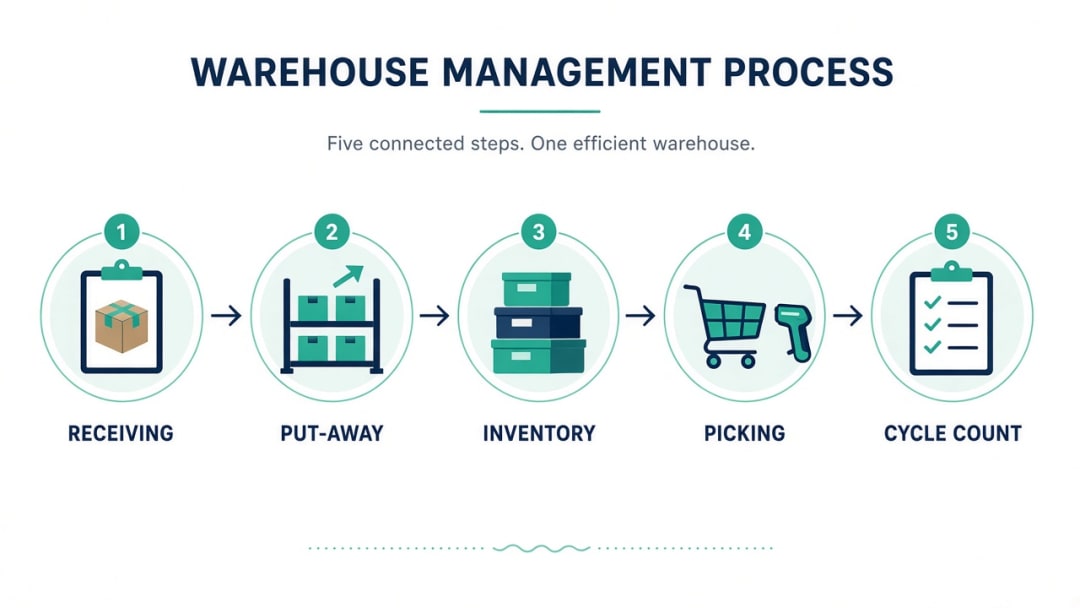
Build the core loop before the brochure
Most failed custom projects over-index on screens and under-index on inventory truth. If bin-level data is wrong, smarter routing only accelerates wrong work.
Receiving and put-away
Confirm what arrived, record discrepancies, and direct stock to a known bin or location.
Location-level inventory
Record where inventory lives and every movement between receiving, storage, picking, and other locations.
Picking and packing
Create prioritized work, efficient routes, item verification, and packing checks with fewer decisions during the pick.
Shipping handoff
Complete and communicate warehouse work cleanly without rebuilding carrier services already purchased elsewhere.
Cycle counting
Use continuous targeted counts, discrepancy investigation, and accountable record updates instead of relying only on an annual freeze.
Defer until the core is sound
Returns depth, labor dashboards, forecasting, robotics, and custom analytics come after on-hand and available inventory are dependable.
How much does a custom WMS cost?
“Custom WMS” can describe three very different bills: a greenfield build, a packaged mid-market product, or a configurable usage-priced WMS. Compare the complete cost, including ownership after go-live.
Greenfield custom development
| Scope | Directional build cost | Typical first-release timeline |
Narrow MVP | About $30,000–$180,000 | Several months |
Fuller custom WMS | About $80,000–$300,000+ | Many months to 1+ year |
Full-scale, multi-site, or heavy automation | About $200,000–$400,000+ | Often multi-year including discovery, validation, and rollout |
These are industry ranges from custom-software vendors, not quotes. Estimates often omit the roadmap, QA, device and browser support, downtime response, training, and rework when upstream APIs change.
SKUSavvy public pricing
SKUSavvy is a configurable Shopify warehouse system. Public list pricing from the draft should still be verified on the pricing page for the current volume calculation.
| Item | Amount |
Base | $179/month, including the first 249 orders |
Extra orders | Graduated $0.20 → $0.06 per order as volume rises |
Users | Unlimited; no per-seat fee |
Trial | 30 days; no card required to start |
Optional hands-on onboarding | $2,750 + $250/month support; cancel anytime |
Worked examples from the draft calculator: about $324/month at 1,000 orders, $1,084 at 5,000, $2,384 at 15,000, and $3,034 at 20,000. These are software-only figures before postage. Online and POS orders, purchase orders, and transfers entering SKUSavvy count toward the total.
Build vs. buy vs. configure
| Path | How you pay | Flexibility on the floor | Who owns the product |
Custom build | Large upfront cost plus perpetual maintenance | Maximum if you keep funding it | You |
Stricter packaged WMS | High fixed monthly or annual cost; often seats | Strong workflows, but you adapt to product packaging | Vendor |
Configurable usage WMS | Lower base plus per-order volume | Bins, map, routes, and scans without owning code | Vendor, configured by you |
A responsible build stays narrow: map every movement, define systems of record, build the core first, connect systems that remain, pilot and reconcile, roll out in phases, and add advanced modules only after the data is dependable.
A practical decision framework for Shopify merchants
Shopify already manages storefront and order context. The missing layer is often a mobile warehouse workflow that turns orders into receiving, put-away, picking, and counting while inventory stays synchronized.
Workflow test
Are the hardest requirements genuinely proprietary, or recognizable warehouse tasks with different priorities, locations, and routes?
Ownership test
Do you want to run warehouse operations, or also fund product management, engineering, QA, infrastructure, and support for years?
Economics test
Compare implementation, training, devices, integrations, maintenance, upgrades, user pricing, and workaround costs—not only the first invoice.
Configurable vs. stricter packaged systems
SKUSavvy lets Shopify-first teams configure bins, a 3D warehouse map, routes, scans, and counts. It is a mobile progressive web app that runs in a browser on iOS and Android devices, with no native app-store install; it is not a native iOS or Android store app.
ShipHero is a full mid-market WMS for brands and 3PLs, with deep workflows, a native iOS app, multi-marketplace integrations, and a 3PL billing path. Its older published Brand Standard pricing was around $1,995/month and its 3PL plan around $2,145/month; confirm current pricing and terms with ShipHero. Its commercial model is commonly quote-led, with limited included seats, add-on seats, and annual terms.
| SKUSavvy (configurable) | ShipHero (stricter package) | |
Best fit | In-house Shopify brands shaping their own floor | Brands and 3PLs seeking a full mid-market package |
How custom feels | Configure bins, map, routes, and scans | Adopt product workflows and configure within the package |
Mobile | Browser PWA on phones and tablets, iOS and Android | Native iOS app |
Pricing shape | $179/month plus per-order usage; unlimited users; published | Historically published near $1,995/month and $2,145/month for 3PL; confirm current quotes; seats add cost |
Commerce center | Shopify-first; other channels through Shopify | Direct multi-marketplace integrations |
ShipHero can fit teams needing packaged mid-market depth, iOS-native floor apps, or non-Shopify marketplace integrations. SKUSavvy can fit teams needing floor configuration, published usage pricing, unlimited users, and Shopify at the center.
Custom WMS FAQ
Straight answers to the questions buyers ask while comparing build, buy, and configure paths.
What is a custom WMS?
A custom WMS is warehouse management software built or heavily tailored for one operation’s processes, data model, and integrations. Buyers may mean a greenfield build or simply a WMS flexible enough to match their floor, which a configurable product can often provide.
What does a WMS do that inventory or shipping software does not?
A WMS controls physical work between receiving and shipping: where units live, how they move, what to pick, and how counts stay accurate. Inventory apps often track totals and shipping tools print labels; neither alone directs put-away, bin movements, pick paths, or continuous counts.
Custom WMS vs. off-the-shelf WMS: which should I choose?
Choose off-the-shelf when processes are standard and you will adopt its workflows. Choose custom-built when proprietary processes or equipment create competitive value and configuration cannot represent them. Choose configurable when you need floor fit without owning a software product.
When is building a custom WMS worth it?
Building can be worth it for software intended for resale, proprietary robotics, specialized manufacturing flows, regulated constraints that block configuration, or complex 3PL billing and ownership logic. It is rarely justified by spreadsheets, tribal knowledge, and a shipping tool that never became a warehouse system.
How much does a custom WMS cost?
A greenfield build is commonly estimated at about $30,000–$180,000 for a narrow MVP and $200,000–$400,000+ for fuller systems, based on agency ranges rather than quotes, plus ongoing ownership. ShipHero historically published Brand Standard near $1,995/month; confirm its current quote. SKUSavvy publishes $179/month including about 249 orders, then $0.20–$0.06 per order, with unlimited users.
How long does custom WMS development take?
A narrow MVP can take months. Full greenfield programs can stretch into multi-year efforts once discovery, integrations, validation, phased go-live, and post-launch change are included.
What features should a custom WMS include first?
Prioritize receiving with discrepancy handling, directed put-away, bin-level inventory, pick and pack execution, a clean shipping handoff, and cycle counting. Defer robotics, deep labor suites, and advanced analytics until inventory truth is reliable.
Do Shopify merchants need a custom WMS?
Most in-house Shopify merchants need warehouse execution that syncs with Shopify, not a bespoke codebase. Shopify handles commerce; a mobile WMS layer handles bins, put-away, picks, and counts. Custom development is the exception for truly proprietary processes.
What is a configurable WMS?
A configurable WMS ships working warehouse primitives—locations, movements, scans, routes, counts, and orders—that operators shape through settings and layout rather than commissioning a new product.
Can a progressive web app (PWA) replace a native warehouse app?
For many ecommerce warehouses, yes: a PWA runs in the browser on phones and tablets while supporting scanning, picking, and counting without a native app-store deployment. Evaluate device policy, offline needs, and peripheral support. A PWA is not a native iOS or Android store app.
How does SKUSavvy pricing compare at real order volumes?
At the draft’s public list rates, software costs about $324/month at 1,000 orders, $1,084 at 5,000, and $2,384 at 15,000, before postage. The base is $179 with about 249 orders included; rates fall by volume band, and users are unlimited.
Is ShipHero a custom WMS?
ShipHero is a commercial mid-market WMS, not a from-scratch build. It is a packaged product with strong workflows, iOS-native mobile, multi-channel reach, and a stricter commercial model. Compare that packaged depth with a configurable Shopify-first tool on the requirements that matter.
What questions should I ask a custom WMS vendor before signing?
Ask what belongs in the MVP, who owns code and hosting, how inventory conflicts and floor exceptions are handled, what the complete three-year cost includes, who trains seasonal labor, what happens when an upstream API changes, and whether configuration can reach the same outcome first.
Keep reading
ShipHero alternative
Compare floor workflow, packaging, and pricing considerations.
Read the comparisonFit the WMS to the floor without funding a software company.
Start a 30-day trial or check the public pricing for your order volume.