Cycle Counting Meaning, Explained for Warehouses
Alex
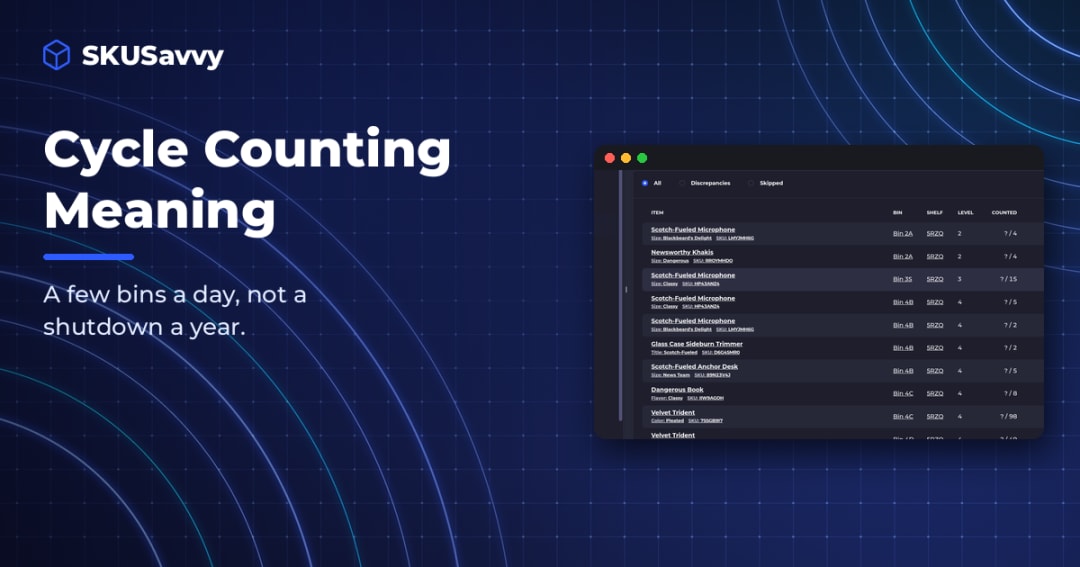
The cycle counting meaning is simple: instead of counting your whole warehouse once a year, you count a small set of bins or items on a regular schedule, so every location gets counted over time while the business keeps shipping.
It's the difference between closing for a weekend to count everything and spending fifteen minutes a day on a few shelves. Below: what cycle counting means in practice, the main methods, how often to count, and what to do when the count doesn't match.
Cycle counting, defined
A cycle count is a partial physical count of inventory. Someone goes to a specific bin, counts what's there, and compares it with what the system says should be there. If the numbers differ, the record is corrected and the difference is logged.
The cycle is the rotation. Over a set period, a month or a quarter for example, the counts add up until every bin has been checked at least once, and the busiest ones more often.
If you already use SKUSavvy and want the button-by-button steps, see our guide to cycle counting across bin locations. This post is the plain-language version.
Cycle counting vs a full physical inventory
| Compare | Cycle counting | Full physical inventory |
|---|---|---|
What's counted | A few bins or items at a time | Everything, all at once |
How often | Daily or weekly, on a rotation | Once or twice a year |
Operations | Keep picking and shipping | Usually stop or slow down |
Errors found | Within days, while the cause is still fresh | Months later, when nobody remembers why |
Who counts | One or two people, in short sessions | The whole team, often with overtime |
Many businesses still do a year-end count for their accountant. Cycle counting doesn't always replace it, but it makes it faster and less surprising, because many errors were already fixed during the year.
Common cycle counting methods
| Method | How it works | Good for |
|---|---|---|
ABC counting | Count the fast or valuable items (A) most often, B less, C least | Catalogs where a small share of SKUs drives most sales |
Random selection | The system picks bins at random each day | Catching problems nobody thought to look for |
By location | Walk an aisle or zone in order until the whole floor is covered | Teams that want a simple, predictable routine |
By criteria | Count every bin holding a certain SKU, product type or tag | Checking a problem product or a new vendor's stock |
Opportunity counts | Count a bin when it's nearly empty or after a pick shortage | Fixing errors right where they show up |
Many warehouses mix two or three of these. A daily system-chosen batch keeps the rotation going, and criteria counts handle a specific problem when one comes up.
How often should you cycle count?
There's no single right number. A useful starting point is to count enough bins each week that every bin is checked at least once a quarter, and your top sellers every month.
Raise the frequency for items that sell fast, cost a lot or are easy to mix up, like sizes and colors of the same product.
Lower it for slow, bulky or sealed stock that rarely moves.
Count more right after a busy season, a move or a new hire group starts picking.
The best signal is your own error rate. If counts keep finding differences in one zone, count that zone more until the cause is fixed.
How a cycle count works, step by step
Choose what to count: specific bins, a system-chosen batch or every bin that matches a filter.
Assign the count to one or more people.
Go to each bin, scan the bin label, then scan or select each item and enter the quantity.
Review the differences between counted and expected before you confirm.
Confirm the count so the record updates, and keep the log of what changed, who counted and when.
Look into any large or repeated difference to find the cause, not just fix the number.
A blind count, where the counter doesn't see the expected quantity, gives a more honest result because people tend to find the number they're told to expect.
What to do with cycle count differences
A difference is a clue. The fix is to update the record, but the value is in asking why it was wrong.
Item found in the wrong bin: usually a put-away or transfer that happened on the floor but not in the system.
Count short: a pick that wasn't recorded, damage, a receiving error or theft.
Count over: a return or receipt that was put on the shelf before it was recorded.
Variant mix-ups: similar items stored side by side without scan checks.
Fix the process behind the pattern, such as scanning at put-away or separating look-alike variants, and the same difference stops coming back.
Cycle counting in SKUSavvy
SKUSavvy is a warehouse system for Shopify sellers. Cycle counts run by bin inside each warehouse, and they're built to fit around daily work.
| Feature | What it gets you |
|---|---|
Three ways to choose bins | Pick bins by hand, let SKUSavvy choose bins based on their products and when they were last counted without skipping uncounted bins, or count every bin that matches SKUs, product types or tags |
Counts while you keep picking | Inventory updates in real time, so picking from a bin in an open count doesn't break the count |
Scan checks you control | Turn bin scans and item scans on or off for counts |
Blind counts | Hide the expected quantity so staff count what's really there |
Assign the work | Split a count across employees and see completion status |
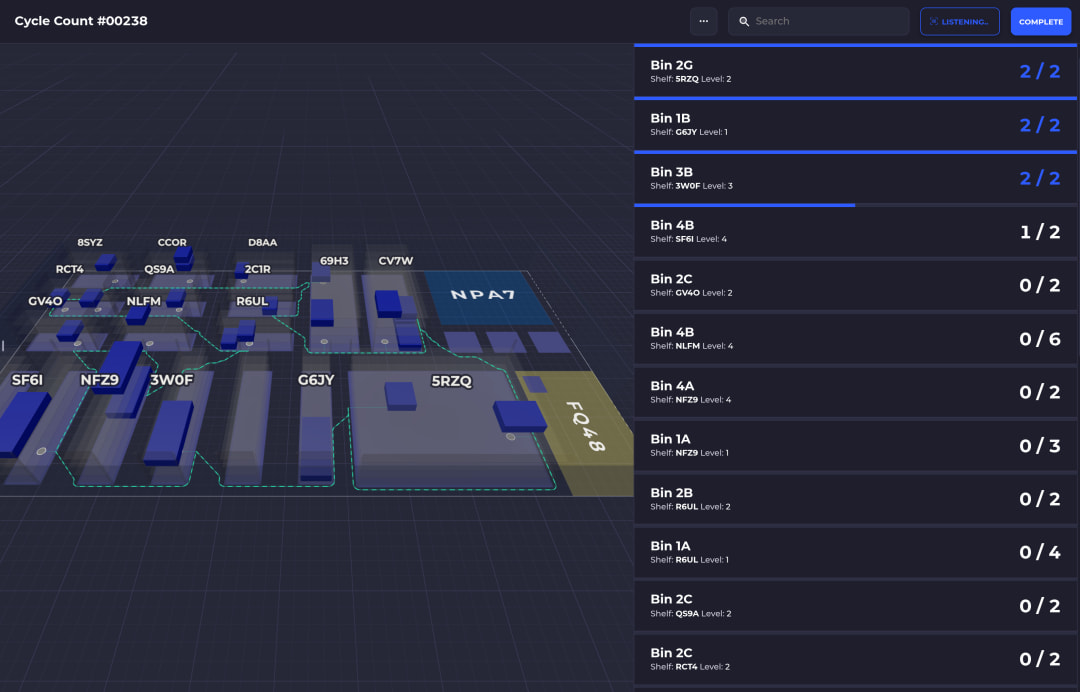
The bin on the map | Each bin shows on your warehouse layout, with an optional 3D map view for the count path |
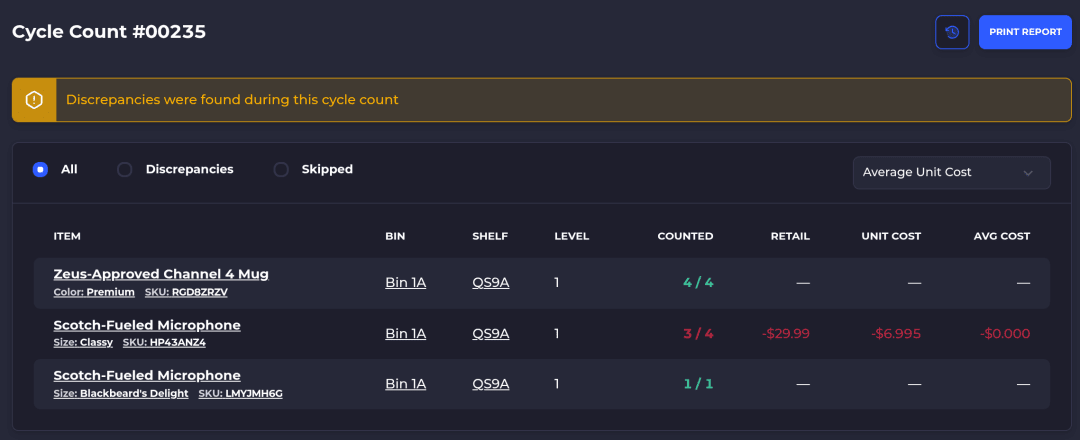
Differences on the record | Review discrepancies before confirming; each change goes to the inventory log with who counted, when and which bin |
For how counted stock stays in step with your store and your other locations, see SKU-based inventory.
As of October 17, 2026, SKUSavvy is $179/month, which covers your first 249 orders, with a per-order rate past that which falls as volume grows. Users are unlimited, so adding counters doesn't add seats. Plans are month to month and the 30-day trial needs no credit card.
Start a 30-day trialCycle counting FAQ
What does cycle counting mean?
Counting a small part of your inventory on a regular schedule, so that over time every location is counted without shutting down for a full count.
What is the purpose of cycle counting?
To keep inventory records accurate all year, find errors while the cause is still easy to trace, and avoid the cost and downtime of frequent full counts.
What is the difference between cycle counting and physical inventory?
A physical inventory counts everything at once, usually once or twice a year. Cycle counting spreads smaller counts across the year while operations continue.
What is ABC cycle counting?
A method that sorts items by value or sales into A, B and C groups and counts A items most often and C items least.
Can you cycle count while still picking orders?
Yes, if your system handles it. In SKUSavvy, cycle count inventory updates in real time, so picking from a bin in an open count doesn't affect the count.
Keep reading
Cycle counting across bin locations
Step-by-step: manual, automatic and criteria counts, scan settings, discrepancies and logs in SKUSavvy.
Read the guideSKU-based inventory
Organize and track stock by SKU and by bin, in step with your Shopify store.
See how it worksA few bins a day beats a shutdown a year.
Start a 30-day trial or check pricing for your order volume.